

ExpressWithACard Blog
The Half-Life of Skills: Why ‘Learning Agility’ is the Only Competitive Advantage in 2026
 February 26, 2026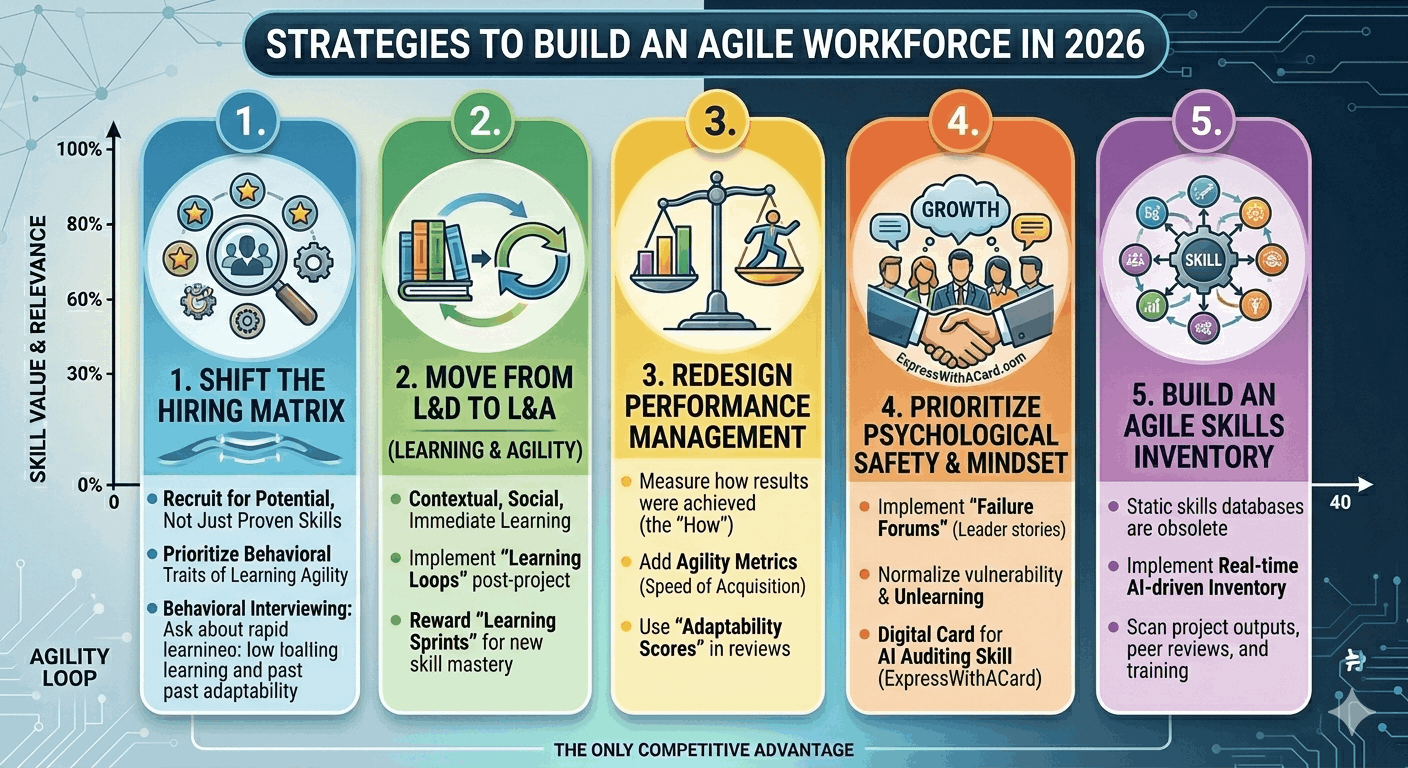
The Half-Life of Skills: Why ‘Learning Agility’ is the Only Competitive Advantage in 2026
The year 2026 has marked a definitive turning point in the global workforce. The traditional concept of a "career," where a worker acquires a discrete set of skills in their youth and leverages them for forty years, has officially crumbled. We are witnessing the dawn of the Reskill Economy, a volatile environment where the value of technical knowledge depreciates faster than new software versions.
Historically, professional skills were durable. A civil engineer graduating in 1980 could expect their technical proficiency to remain relevant for most of their working life. Today, a data scientist or software developer graduating in 2026 faces a startling reality: nearly 50% of the knowledge they acquired during their four-year degree is obsolete by the time they cross the graduation stage.
This phenomenon, known as the "half-life of skills," is not new, but its acceleration is. The arrival of Agentic AI, the globalization of digital labor, and the rapid pace of automation have shortened this half-life dramatically. Technical skills that once offered a decades-long competitive advantage now offer an eighteen-month head start.
In this context, organizations must confront a fundamental truth: You cannot hire or train your way out of the skills gap using old models. The only sustainable competitive advantage in 2026 for both individuals and organizations is not what you know right now, but how fast you can learn, unlearn, and relearn. This capability is known as Learning Agility.
This article provides a minimum 2000-word analysis of why skills are evaporating, defines learning agility, and outlines the five actionable strategies HR leaders must adopt to build an agile, future-proof workforce.
Part 1: The New Calculus of Competence: Understanding the Half-Life of Skills
What do we mean when we talk about the "half-life" of a skill? Borrowed from nuclear physics, the concept describes the time it takes for a skill to lose half of its value or relevance in the marketplace.
A generation ago, the half-life of a learned professional skill was estimated at 10 to 15 years. This meant an individual had substantial time to master their craft and generate a significant return on their educational investment. Today, most estimates place the half-life of technical skills at fewer than five years, and in high-tech or AI-adjacent sectors, it is shrinking to less than two years.
This acceleration is driven by three primary forces:
1. The Proliferation of AI and Automation
AI is not just automating routine tasks; it is automating technical expertise. For example, programming languages are evolving so rapidly that proficiency in "legacy" syntax (which might only be 2 years old) is quickly replaced by AI-assisted code generators that require structural logic rather than rote memorization of commands. Skills in "Data Cleaning" have been largely superseded by Agentic AI that performs these tasks autonomously.
2. The Speed of Business and Technological Shift
Markets are hyper-competitive. New software, new platforms, and new methodologies emerge quarterly. A robust knowledge of a specific project management platform becomes irrelevant when the organization pivots to an AI-driven integrated resource planning system.
3. The Digital Shelf-Life of Knowledge
Information is now globally accessible and instantly updatable. When knowledge is readily available to all, the "premium" on simply knowing facts disappears. The advantage shifts to the individual who can contextualize and apply new information the fastest.
The result is the skills paradox: the technical competence required for today’s role is essential, yet it is also a ticking time bomb. The skills that made an employee effective yesterday may make them redundant tomorrow.
Part 2: What is Learning Agility? (And What It Is Not)
In an environment where technical skills are rapidly depreciating, organizations are redefining "potential." The most valuable employees in 2026 are no longer those with the deepest expertise in a single, static area. Instead, they are the individuals who possess high Learning Agility.
Learning Agility is the ability and willingness to learn from experience and subsequently apply that learning to perform successfully under new or first-time conditions.
It is critical to distinguish Learning Agility from related concepts:
- It is not IQ. While cognitive ability is essential, a high IQ does not guarantee an individual can unlearn old habits or adapt to new feedback.
- It is not simply "being smart" or "being technical." Many highly technical experts struggle with learning agility because their expertise gives them a strong sense of certainty, making them resistant to changing their approach when data changes.
- It is not just "curiosity." Curiosity is the engine, but learning agility includes the discipline of feedback and the application of new insights to achieve results.
The Five Dimensions of Learning Agility
According to extensive research, learning agility is not a singular trait but a composite of five distinct dimensions:
- Mental Agility: The ability to examine problems in new ways, comfortable with ambiguity, and able to make connections between seemingly unrelated concepts.
- People Agility: The ability to understand and relate to other people effectively, adapting communication styles and learning from diverse viewpoints.
- Change Agility: A willingness to lead change initiatives, experimenting with new approaches and dealing comfortably with the discomfort of transitions.
- Results Agility: The ability to deliver results in challenging first-time situations by inspiring teams and exhibiting presence.
- Self-Awareness: The critical dimension. Highly agile learners know their own strengths and weaknesses and are constantly seeking feedback to improve.
Part 3: Why Learning Agility is the Only Competitive Advantage in 2026
In 2026, a static skill set is not an asset; it is a liability. Learning agility is the only sustainable competitive advantage because it is the only competency that is future-proof by definition.
1. The End of Predictable Talent Pipelines
In the past, HR leaders could predict which skills they would need in three years and build pipelines accordingly. The speed of change in 2026 makes this "predict-and-provide" model obsolete. You cannot predict the precise technical skills needed for 2028. You can, however, guarantee that you will need employees who can rapidly master whatever those skills turn out to be.
2. The Talent Scarcity Crisis
The demand for emerging skills (e.g., Quantum Computing Ethics, AI Bias Auditing) vastly outstrips the supply. Organizations cannot simply "buy" talent to close their skills gap. They must "build" it from within. But you cannot build a skill if the employee is not agile enough to learn it quickly. Learning agility is the prerequisite for reskilling.
3. Retention is No Longer the Goal; Continuity is.
In the modern workforce, the average tenure of an employee is significantly shorter than in the past. Attempting to retain employees indefinitely is a losing battle. The goal must shift to organizational continuity. An agile workforce ensures that when an employee leaves, their replacement can learn the necessary skills quickly, or that the organization can rapidly restructure the role to suit a new set of capabilities.
4. Innovation Required "Unlearning"
Innovation is not just about adopting the new; it is about abandoning the old. Employees who lack learning agility cling to the methodologies that worked in the past ("We’ve always done it this way"), becoming roadblocks to necessary technological adoption. Agile learners possess the humility and cognitive flexibility to "unlearn" comfortable habits in favor of more effective, albeit unfamiliar, ones.
5. AI Amplifies Agile Learners
AI tools are force multipliers, but only for those who can quickly learn how to prompt, navigate, and synthesize their output. Employees with low agility see AI as a threat to their job function; agile employees see AI as a tool that accelerates their own learning curve, allowing them to shift from rote technical work to high-level strategic decision-making.
Part 4: How HR Leaders Must Pivot to Build an Agile Workforce
The imperative for HR leaders in 2026 is clear: The traditional pillars of Human Capital Management Hiring for Experience, Training for Competence, and Performance-Based Reviews must be reinvented to support Learning Agility.
Here are five actionable strategies for HR leaders:
1. Shift the Hiring Matrix: Recruit for Potential, Not Just Proven Skills
The 2026 job description must prioritize behavioral traits of learning agility over technical certifications.
- Actionable Step: Redesign your behavioral interview questions to assess past agility. Instead of asking "Tell me about a time you solved X technical problem," ask: "Tell me about a time you had to learn an entirely new methodology in less than 30 days. How did you do it? What mistakes did you make, and what did you learn?"
- The Outcome: You hire employees who may not know everything on Day 1 but who will know the right things by Day 60.
2. Move from L&D to L&A (Learning & Agility)
The standard training library of 2,000 on-demand courses is dead. In 2026, learning must be contextual, social, and immediate.
- Actionable Step: Create "Learning Loops." After any major project or organizational change, implement a mandatory structured retrospective focused not on what was done, but on how the team learned. What processes did they invent? What assumptions were wrong?
- Actionable Step: Incentivize Learning Sprints. Reward teams that master a new skill in 90 days, prioritizing the speed of mastery over the absolute level of competence.
3. Redesign Performance Management to Reward Agility and Adaptability
Performance reviews in 2026 must measure how results were achieved, not just that they were achieved.
- Actionable Step: Add "Agility Metrics" to performance reviews. Measure "Speed of Skill Acquisition" and "Adaptability Score" (based on feedback and peer reviews regarding an employee's reaction to change).
- The Outcome: This sends a clear signal that clingy reliance on legacy expertise is not a long-term strategy. It aligns recognition with the behavior necessary for organizational survival.
4. Prioritize Psychological Safety and a "Growth Mindset"
Employees will only experiment, fail, and seek feedback all essential for agility if they believe their organization rewards growth more than perfection.
- Actionable Step: Implement "Failure Forums." Leaders must publicly share their own professional mistakes and the subsequent learnings. This normalizes vulnerability and unlearning.
- Actionable Step: Formalize recognition of learning. When an employee spends six months mastering a new, difficult AI tool, use a platform like ExpressWithACard.com to send a group digital card signed by peers and leadership, celebrating their "Commitment to Continuous Growth." This relational recognition is powerful because it validates the difficult emotional labor of unlearning and relearning.
5. Build a Skills Inventory (But Make it Agile)
To understand your future capability, you must know your current skills. However, a static skills database is obsolete.
- Actionable Step: Implement a real-time AI-driven Skills Inventory. These tools dynamically scan project outputs, peer reviews, and even completed training modules to provide a rolling snapshot of organizational capabilities.
- The Outcome: This provides visibility not just into what skills you have, but how quickly those skills are changing, allowing HR to identify individuals with the highest learning velocity.
Conclusion: The Final Skill Set is No Skill Set
The era of "competence" is ending. The era of "learning velocity" has begun. In 2026, the specific technical skills your organization possesses are temporary tactical tools. Your only enduring, long-term competitive advantage is your collective Learning Agility.
For organizations, this requires a fundamental paradigm shift. Talent is no longer a resource to be managed, but an agile system to be optimized for adaptation. The winners of 2026 will not be the smartest organizations; they will be the most flexible.
The transformation starts by recognizing that when skills expire, the only thing that retains value is the willingness to let them go and the agility to embrace what comes next.