

ExpressWithACard Blog
How to Improve Remote Employee Engagement: 10 Strategies That Actually Work
 February 26, 2026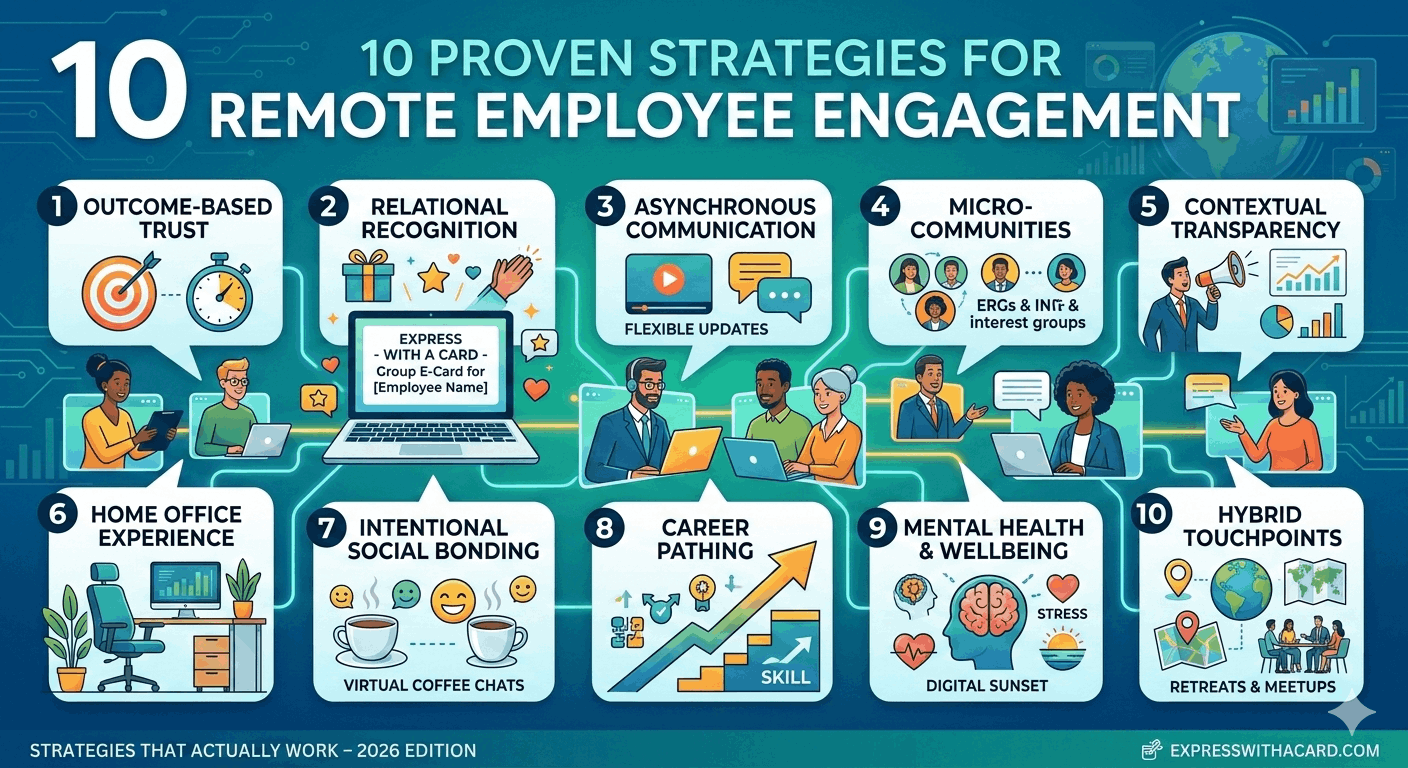
How to Improve Remote Employee Engagement: 10 Strategies That Actually Work
The shift toward remote and hybrid work is no longer a “trend” it is the baseline of the modern economy. As we navigate 2026, the initial novelty of working from home has faded, replaced by the stark reality of "digital exhaustion" and "connection deficits."
For HR professionals and business leaders, the challenge has evolved. It is no longer about whether employees can work from home; it is about whether they feel connected while doing so. High engagement is the engine of retention, productivity, and innovation. Without it, your remote workforce becomes a collection of independent contractors rather than a cohesive team.
In this comprehensive guide, we explore 10 battle-tested strategies to revitalize remote employee engagement and build a culture that transcends physical borders.
1. Move From "Digital Supervision" to "Outcome-Based Trust"
The quickest way to kill engagement in a remote environment is micromanagement. In 2026, "mouse-tracking" software and constant status pings are viewed as relics of a low-trust past.
The Strategy:
Shift your management philosophy toward Objective and Key Results (OKRs). When employees are judged by the quality and impact of their output rather than the hours they spent "active" on Slack, they feel empowered. Empowerment breeds ownership, and ownership is the foundation of engagement.
- Action Step: Train managers to set clear, measurable weekly goals. If the work is done well and on time, the "how" and "when" should belong to the employee.
2. Master the Art of "Relational Recognition"
In a physical office, recognition often happens spontaneously a pat on the back or a quick "great job" in the hallway. In a remote setting, these moments must be intentional.
However, generic "shout-outs" in a crowded Zoom meeting can feel performative. You need Relational Recognition, which is personal, tangible, and communal.
The Strategy:
Use dedicated tools to celebrate life and career milestones. For birthdays, work anniversaries, or project completions, a digital group card allows the entire team to leave personalized messages, GIFs, and memories. For example, platforms like ExpressWithACard.com make it easy for global teams to collaborate on a high-quality digital card that feels more personal than a standard email.
- Action Step: Create a "Recognition Calendar" so no employee milestone goes unnoticed. Integrating a tool like ExpressWithACard.com into your Slack or Teams workflow ensures that celebrating a peer is a low-friction, high-impact activity.
3. Solve for "Digital Exhaustion" with Asynchronous Communication
"Zoom fatigue" is a medical reality. If your remote engagement strategy involves more meetings, you are likely doing it wrong. High engagement requires "Deep Work" time periods where employees can focus without the anxiety of incoming pings.
The Strategy:
Adopt an Asynchronous-First communication policy. This means using recorded video snippets (like Loom), shared documents, and project management boards for updates, saving live meetings for complex problem-solving or social bonding.
- Action Step: Audit your recurring meetings. If a meeting is simply for "status updates," cancel it and move it to a shared dashboard or an async thread.
4. Foster "Micro-Communities" within the Macro-Culture
It is hard for an employee to feel engaged with a 500-person company from their living room. Engagement happens in small groups.
The Strategy:
Encourage the formation of Employee Resource Groups (ERGs) or "Interest Channels" that have nothing to do with work. Whether it’s a #pet-parents channel, a remote book club, or a gaming group, these micro-communities provide the "water cooler" talk that remote work lacks.
- Action Step: Allocate a small monthly budget for these groups. A $50 "coffee fund" for a virtual book club can yield a massive ROI in terms of employee belonging.
5. Prioritize "Contextual Transparency"
Remote employees often feel like they are working in a vacuum. When they don't know why certain decisions are being made at the executive level, they feel undervalued and disconnected from the company's mission.
The Strategy:
Implement "Ask Me Anything" (AMA) sessions with leadership. But go beyond the meeting provide a "Internal Wiki" where the "why" behind every major company pivot is documented.
- Action Step: Record a 5-minute "State of the Department" video every Monday. It humanizes leadership and ensures everyone is rowing in the same direction.
6. Invest in the "Home Office Experience"
An employee’s physical environment directly impacts their mental engagement. If they are hunched over a kitchen table, their productivity and mood will suffer.
The Strategy:
Move beyond a one-time "onboarding stipend." Offer an annual "Work from Home" (WFH) Refresh Fund. This allows employees to upgrade their ergonomics, lighting, or even their home internet as technology advances.
- Action Step: Provide a curated list of ergonomic equipment. Showing that you care about their physical health sends a powerful message of support.
7. Create "Intentional Friction" for Social Bonding
In the office, social bonding is accidental. In remote work, you have to create “intentional friction” moments where people are forced to stop working and start interacting as humans.
The Strategy:
"Virtual Coffee Roulettes" are a great start. Use an app that randomly pairs two employees from different departments for a 15-minute non-work chat.
- Action Step: For team wins, send a digital gift card through a service like ExpressWithACard.com alongside a group card signed by the execs. Combining a personal message with a small reward creates a "peak moment" in an otherwise routine digital day.
8. Career Pathing in a Borderless World
Remote employees often fear they are "out of sight, out of mind" when it comes to promotions. This "proximity bias" is a major driver of disengagement.
The Strategy:
Formalize Skills-Based Pathing. Create a transparent map of the skills required for the next level in their career. Use an Internal Marketplace where remote workers can "gig" on projects in other departments to build those skills.
- Action Step: Schedule "Career Growth" chats quarterly that are strictly separate from performance reviews. Focus entirely on where the employee wants to go, not just what they are currently doing.
9. Mental Health as a Metric, Not a Perk
In 2026, a subscription to a meditation app is no longer enough. Engagement is tied to psychological safety and mental well-being.
The Strategy:
Normalize "Mental Health Days" and "Focus Fridays" (no-meeting days). More importantly, managers must lead by example. If a VP is sending emails at 9:00 PM on a Sunday, the team will feel pressured to be "always on," leading to burnout.
- Action Step: Implement a "Digital Sunset" policy. Encourage employees to set their Slack status to "Away" and turn off notifications after their local working hours.
10. The Power of the "In-Person" Hybrid Touchpoint
Paradoxically, the best way to improve remote engagement is occasionally not being remote.
The Strategy:
If budget allows, host annual or semi-annual retreats. However, if your team is global and decentralized, focus on "Regional Meetups." Support local clusters of employees getting together for lunch or a co-working day.
- Action Step: Even if you can't meet in person, use highly interactive digital experiences. A collaborative "Year in Review" digital card from ExpressWithACard.com can serve as a virtual yearbook, collecting photos and memories from the year that celebrate the team’s collective journey.
Summary of Engagement Strategies
| Strategy | Primary Benefit | Effort Level |
|---|---|---|
| Outcome-Based Trust | Increases Autonomy | High (Cultural Shift) |
| Relational Recognition | Boosts Belonging | Low (Using ExpressWithACard.com) |
| Async Communication | Reduces Burnout | Medium |
| Micro-Communities | Build Social Capital | Low |
| Transparency | Aligns Purpose | Medium |
The 2026 Engagement Outlook
Remote work is not a barrier to culture; it is a different medium for it. The companies that will win the talent war in the coming years are those that stop trying to replicate the office online and start building a "Digital-First" experience that respects an employee's time, celebrates their individuality, and rewards their results.
By utilizing tools like ExpressWithACard.com for personalized recognition and committing to a culture of trust and transparency, you can turn a disconnected group of remote workers into a high-performing, highly engaged team.